Devil’s Island
An Officer and a SpyDevil’s Island is the isolated penal site to which Alfred Dreyfus was sent after his conviction, and the setting of the confinement that makes his punishment seem designed to sever him from ordinary human contact. Far from Paris and difficult to reach even by boat, it is reopened specifically for him. In Georges Picquart’s account, the island becomes more than the destination of a sentence: it is the distant place whose censored letters bring Dreyfus’s continuing experience back into the investigation.
Location and Purpose
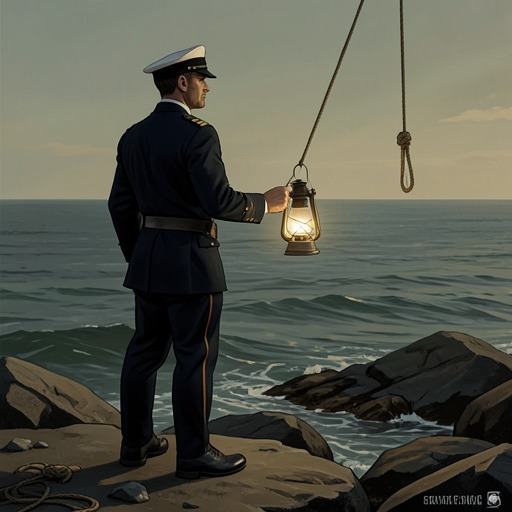
A minister identifies Devil’s Island on a globe as a point off the coast of South America, about seven thousand kilometres from Paris and fifteen kilometres offshore. The sea around it, together with its waves and strong currents, makes landing difficult. Its position supplies a practical barrier to escape and access, while the island’s remoteness gives the punishment a scale beyond that of an ordinary prison term.
The island had been closed for years before Dreyfus’s case. The minister says it will be reopened especially for him, subject to approval in the Chamber of Deputies. Dreyfus is therefore not simply transferred to an existing prison: the destination is made operational again for the purpose of holding one man. That decision anticipates the exceptional character of the regime described later in the book, in which separation from other people is built into the place and its daily arrangements.
Deportation and Arrival
After a final visit with Lucie Dreyfus on the Île de Ré, Dreyfus is taken aboard the warship Saint-Nazaire and sent across the Atlantic. The visit has been governed by restrictions: husband and wife must remain apart, guards supervise the meeting, and a request for Lucie to approach more closely is refused. Their subsequent letters express affection and admiration, but hours after the visit Dreyfus is already at sea. The journey thus begins with a separation imposed not only by distance but by rules controlling even their last in-person contact.
Dreyfus’s destination is withheld from him during the voyage. He guesses that he is being taken to Cayenne; on the fifteenth day, the ship anchors near three small islands: Royal Island, St Joseph’s Island, and Devil’s Island. He discovers that Devil’s Island is intended for him alone. While its former penal settlement is cleared and his quarters prepared, he is kept on Royal Island. After thirty days of close confinement there, he is moved to the island assigned to him. The sequence—an unknown destination, temporary detention nearby, and eventual transfer to a prepared hut—makes arrival a process of controlled uncertainty rather than a single landing.
The Confinement Regime
On Devil’s Island, Dreyfus may walk during the day only within a small designated area, followed at every step by armed warders. At six in the evening he is locked into a hut four metres square, enclosed by an iron grille, while guards take turns keeping watch outside through the night. The daily arrangement reduces movement to a bounded patch of ground and makes the hut both living quarters and a nightly lockup.
The account also records the practical demands of maintaining himself there. His rations consist of half a loaf of bread each day, meat three times a week, and tinned bacon on the other days; water is provided for drinking. He must gather fuel, cook, clean his clothes, and try to dry them in the humid climate. These details show that isolation is administered through ordinary necessities as well as barriers and guards: daily life is restricted to a small space and the work required to sustain it.
The letters describe a wider deprivation of communication. Warders do not speak to Dreyfus, and later they are forbidden to answer even routine questions about his mail. Correspondence from Cayenne does not always bring the letters he expects; eventually, he reports having nothing to read, with books and magazines no longer reaching him. The censored pages preserve these complaints because the Colonial Ministry forwards his correspondence for review. The prison’s isolation therefore extends beyond geography: information and contact pass through official controls.
A Prison Seen Through the Files
For much of the narrative, Devil’s Island is encountered through documents rather than through a separate visit. The Colonial Ministry sends batches of Dreyfus’s censored correspondence to Picquart, who reads them in his office. The file changes the island from an abstract point on a map into the setting of a continuing, documented life: Dreyfus writes about the limits of his confinement, the absence of mail, and his wish to survive until the truth is discovered. Picquart’s access to these papers is institutional, but what he reads increasingly bears on his understanding of the man imprisoned there.
One passage catches Picquart’s attention because Dreyfus refers to the philosopher Schopenhauer. Picquart recognizes the thought from his own reading and is surprised that Dreyfus might share an intellectual point of reference he had not associated with him. The connection does not immediately produce a public intervention: Picquart writes to the Colonial Minister that he has no observations from an intelligence perspective. Yet he finishes the file thinking about Dreyfus. The island’s correspondence has begun to unsettle the distance between the officer reviewing a case and the prisoner represented in its papers.
Narrative Significance
The island returns later as a chronological reference point in Picquart’s investigation. When he shows a handwriting sample to an officer, he establishes that it cannot have been written by Dreyfus, whom he identifies as the man on Devil’s Island, because the letter dates from the previous month. The location thus marks the conditions of Dreyfus’s imprisonment while also helping to distinguish his circumstances from those of another possible author. Its presence in the reasoning is concise but consequential: an exile imposed on Dreyfus becomes part of the evidence by which Picquart tests an attribution.
The narrative’s use of Devil’s Island holds together physical distance and documentary proximity. Its offshore position and guarded perimeter isolate Dreyfus; the letters carried back through government channels allow his situation to recur inside Picquart’s investigation. The island is at once the remote endpoint of the sentence and a continuing presence in the files. That contrast makes the apparent closure of Dreyfus’s case harder to sustain: although he has been removed from Paris, his recorded words keep returning to the people and questions the sentence was meant to leave behind.